The Mariana Snailfish Uses a Specialized Pressure Shield to Survive at the Extreme Ocean Depths
The Mariana snailfish is the deepest-living vertebrate on Earth, thriving nearly 8,000 meters below the surface. To survive pressure that would crush submarines, it accumulates extraordinary levels of trimethylamine N-oxide (TMAO), a small molecule that keeps its cellular proteins from unfolding. This unique biochemical adaptation sets a hard evolutionary limit on how deep fish can swim.
Published
Filed under
Byline
 Brainblast archive
AI-generated with OpenAI; reviewed by Brainblast
The fact
“The Mariana snailfish (Pseudoliparis swirei) thrives at depths of up to 8,143 meters in the Mariana Trench, where hydrostatic pressure reaches up to 1,000 times that of sea level. At these extreme depths, immense pressure would normally force water molecules into the hydrophobic cores of proteins, disrupting their precise three-dimensional structures and causing lethal denaturation. To survive, the snailfish produces extraordinary concentrations of trimethylamine N-oxide (TMAO), a specialized organic compound that functions as a 'piezolyte'—a pressure solute. TMAO alters the hydrogen-bonding network of surrounding water molecules, rendering the water more rigid and preventing it from infiltrating and unfolding the fish's cellular proteins. Interestingly, this adaptation creates a hard physiological limit for all marine fish. Above depths of approximately 8,200 to 8,400 meters, the concentration of TMAO required to stabilize proteins would make the cells hyperosmotic compared to surrounding seawater, causing water to uncontrollably flood the cells. This osmotic barrier explains why no fish has ever been found in the deepest 25 percent of the ocean.”
The Mariana Snailfish: Cellular Survival at the Ocean's Absolute Depth Limit
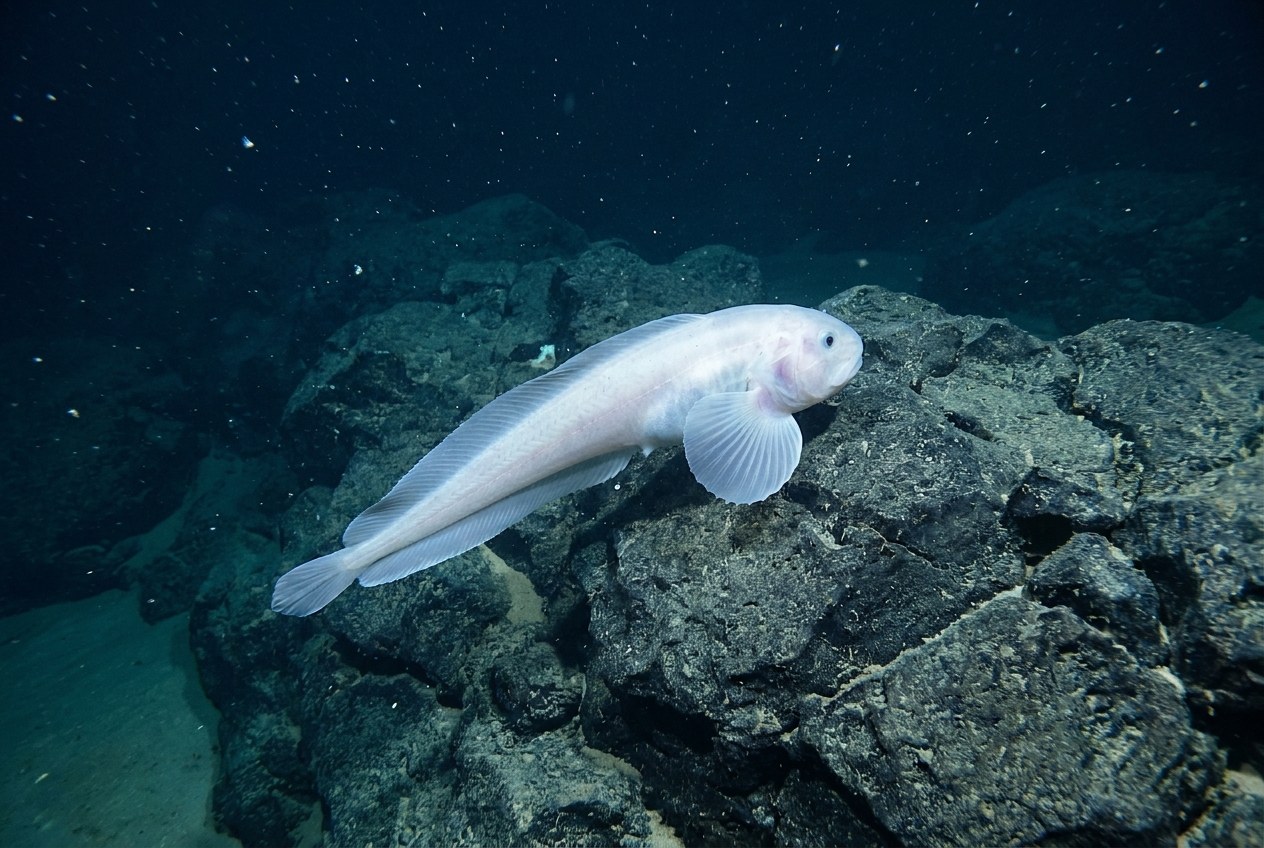
The hadal zone, encompassing the deepest trenches of the global ocean from 6,000 to 11,000 meters, represents one of the most hostile environments on planet Earth. At these profound depths, the water column exerts crushing hydrostatic pressures of up to 1,000 atmospheres (approximately 100 megapascals)—equivalent to the weight of an elephant standing on a human thumb. Yet, in the perpetual darkness of the Mariana Trench, a ghost-white, scale-less fish named the Mariana snailfish (Pseudoliparis swirei) thrives at depths of nearly 8,000 meters, making it the deepest-living vertebrate discovered. The survival of this remarkable creature is made possible by a specialized chemical pressure shield: a high concentration of the organic osmolyte trimethylamine N-oxide (TMAO), which protects its cellular machinery from the crushing force of the deep.
The Biophysical Threat: Pressure-Induced Protein Denaturation
To appreciate the snailfish's adaptation, one must understand how extreme hydrostatic pressure impacts basic biology. For shallow-water organisms, high pressure is a lethal force, not simply because it compresses air spaces, but because it disrupts cellular chemistry at the molecular scale. Under extreme pressure, water molecules are forcefully driven into the hydrophobic interiors of proteins, disrupting the delicate non-covalent hydrogen and electrostatic bonds that hold these macromolecules in their precise three-dimensional shapes.
When a protein's structure is compromised, it undergoes denaturation, unfolding and losing its functional capacity. Because life depends on the highly coordinated and specific interactions of folded proteins, such as enzymes, receptors, and structural elements, widespread protein unfolding is rapidly fatal. For standard marine fish, descending into the hadal zone would lead to instant cellular collapse as their nervous systems, muscles, and metabolic pathways cease to function.
Trimethylamine N-Oxide: The Molecular "Piezolyte" Shield
The Mariana snailfish overcomes this barrier by employing a unique biochemistry characterized by a massive accumulation of trimethylamine N-oxide (TMAO) within its muscle and organ tissues. TMAO is a small, polar organic molecule that functions as a "piezolyte"—a solute that specifically stabilizes proteins against the denaturing effects of high hydrostatic pressure.
The mechanism of TMAO is elegant. Rather than binding directly to the proteins to lock them in place, TMAO acts on the surrounding solvent. As demonstrated in research by Proceedings of the National Academy of Sciences, TMAO is strongly excluded from the peptide backbone and hydrophobic surfaces of proteins. Instead, it strongly interacts with water molecules, altering the local hydrogen-bonding network and rendering the water structure more rigid and thermodynamically cohesive. This enhanced water-water network makes it energetically unfavorable for water molecules to invade the protein's hydrophobic core, thereby forcing the protein to remain in its compact, functional, folded state even under extreme external pressure.
Genetic Adaptations for TMAO Superproduction
Accumulating these vast quantities of TMAO requires specific molecular machinery. A groundbreaking genomic analysis of the Mariana snailfish conducted by Kun Wang and colleagues in 2019 revealed that the fish's genome has evolved specialized modifications to support this.
The primary enzyme responsible for synthesizing TMAO from precursor dietary compounds is flavin-containing monooxygenase 3 (FMO3). While typical bony fishes possess only one or two copies of the fmo3 gene, the Mariana snailfish has undergone genetic duplication and regulatory changes. Its fmo3 genes feature multiple active promoter regions that heavily upregulate the expression of the FMO3 enzyme. This genetic "volume dial" allows the snailfish to synthesize and maintain TMAO at rates exponentially higher than shallow-water relatives.
Furthermore, the fish is aided by skeletal adaptations. According to studies highlighted by SUNY Geneseo, deep-sea snailfishes exhibit highly reduced bone calcification. Their skeletons remain flexible and cartilaginous, particularly in the skull, preventing their bones from shattering under pressure.
The Depth-Limit Hypothesis: Why Fish Have an Absolute Ceiling
The reliance on TMAO to survive extreme depths exposes a fundamental biochemical trade-off that determines the absolute depth ceiling for all fish species. In 2014, marine biologists proposed the depth-limit hypothesis, noting that TMAO concentrations in fish muscle tissue increase linearly with depth.
As a fish lives deeper, its internal tissue osmolality rises alongside the increasing TMAO levels. At a depth of approximately 8,200 to 8,400 meters, the internal salt and osmolyte concentration of the fish's cells becomes hyperosmotic compared to the surrounding seawater, which rests around 1,100 mOsmol/kg.
If a fish were to descend below this threshold, the osmotic gradient would reverse. Seawater would continuously rush into the fish's cells via osmosis, a condition that marine bony fishes are physiologically incapable of managing. This osmotic barrier represents an absolute physiological boundary. It explains why, despite numerous deep-ocean expeditions including those conducted by the University of Hawaiʻi, no living fish of any species has ever been captured or filmed below 8,400 meters. The deepest-living vertebrates are bound to their hadal trenches by the very chemical shield that allows them to survive there in the first place.